

.Guest Blog Posr
Summer is a favourite time for children to play, explore, and relax. But parents often worry about the summer slide, that children may lose the skills and knowledge they have gained during the school year.
Something will definitely be forgotten, and this cannot be avoided, but losses can be minimized, especially in the core subjects of reading and maths. Family days out in Dartmouth give kids a chance to practice reading, maths, science, and observation through real-world activities.
Why Summer Days Out Are Prime Learning Time
For families planning days out with kids to Devon, the city, the harbor, the beaches, and the surrounding countryside offer plenty of opportunities for real-world learning. When kids can apply what they are learning to real-world situations, they learn more effectively. A day trip can transform an easy activity into a quick educational assignment, while structured resources like the Brighterly reading program can help children continue practicing their reading skills at home.
- Learn about the history of the area by reading the signs and information boards when you visit a castle.
- Look for shapes, count vessels, and compare their sizes as you go about the harbor.
- Go to the beach, measure items, count shells, and organize your findings.
- Investigate a rock pool: Keep a journal of your observations of marine life.
- Examine a map of Dartmouth: Determine whether locations on the map are closer or farther away.
What the “summer slide” actually costs kids
When school resumes, kids who haven’t practiced a skill for a few weeks can require some time to pick it up again. This can be particularly apparent when it comes to abilities like reading, spelling, and basic math facts that need practice.
Children don’t necessarily have to use worksheets all summer. Study what your child already enjoys and is familiar with, gradually adding new knowledge. For example, have your child write about what they saw today, count the boats in the harbor, compare the lengths of trees, or read a description of a painting in a museum. Yes, a family vacation won’t turn into a constant learning experience, but your child won’t be idle either.
Why learning through play sticks better than drills
Learning through play gives children the opportunity to recall what they have learned. For example, they count boats using math, or read the name of a new dish using reading skills, or learn about a castle by studying history and new facts.
Additionally, it allows parents to discover what their child truly comprehends. For instance, a child may need more practice using the concept in real life if they can recognize a triangle on a worksheet but are unable to locate one on a building.
Dartmouth Castle & the Harbor: History and Storytelling
A good place to start an instructive day trip is Dartmouth Castle. In order to defend Dartmouth and its harbor from French attacks, the castle was begun in 1388. A gun tower and a harbor chain that formerly spanned roughly 250 meters across the entrance to the Dart Estuary were among its later fortifications.
Simple reading games to play on-site
Make brief reading exercises out of information boards and signs. These outdoor learning activities for kids turn a visit to the castle into a chance to practice reading in a real-world setting. Request that your youngster locate one fact about the castle and provide an explanation in their own words. Ask younger kids to locate a specific word or number using a single brief symbol. Older kids can respond to questions like these after reading a paragraph:
- This section of the castle was constructed or utilized by whom?
- What was the purpose of its design?
- What took place here?
- What new fact did you learn?
These activities build reading comprehension for kids because they have to understand information instead of simply reading the words.
Turning a visit into a “story diary” activity
After the visit, ask your child to write five sentences about the day. They could describe the castle, explain what it was used for, or imagine what it would have been like to live there hundreds of years ago.
You can make the task easier for younger children. Let them draw three pictures from the visit and add one sentence under each picture. Older children can write a short diary entry from the point of view of a soldier, sailor, or visitor.
Boats, Bridges, and the River Dart: Spotting Shapes and Geometry
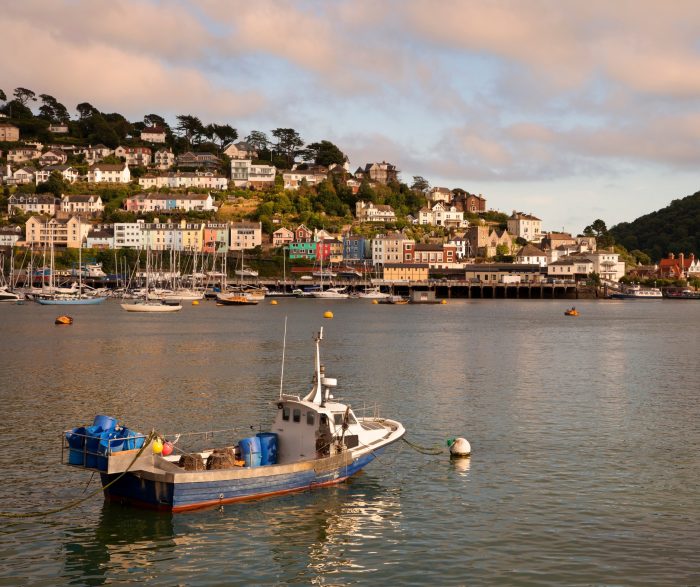
The River Dart and Dartmouth Harbor are great examples of introducing geometry for kids. Boats, windows, bridges, signs, roofs, and buildings are all examples of shapes that children see every day. This way, you can learn about new shapes, their differences, and similarities.
Start with the simple shapes for kids – a square, a circle, a rectangle. Let your child find similar shapes on the playground, count their number, etc. For an older child who already knows simple shapes, you can have them look for parallel lines, right angles, symmetry, and different types of triangles.
If you are looking for more structured learning with a clear plan and a specific goal, you can find geometry tutoring for kids. It will be an additional support between school terms.
A shape-spotting scavenger hunt for younger kids
Give kids a short list of shapes to look for:
- Three circles
- Three rectangles
- Two triangles
- One curved-line object
- One item with a pattern
Angles and symmetry for older kids exploring the harbor
Older kids can compare boat shapes and check for correct angles in buildings. Ask them where they can see lines that go in the same direction and whether a building appears symmetrical.
Another option is to ask them to estimate an angle, which you can then verify using a basic angle tool. Teaching a complete geometry class on the waterfront is not the aim. Its purpose is to assist kids in recognizing how geometry manifests itself in their surroundings.
Rock Pools and Beaches: Counting, Measuring, and Observing
A beach or rock pool is also a good place for math and science activities. Children can count ships and catamarans, and compare the sizes of rocks. Parents don’t have to strain themselves to do this; just ask: which of two shells is longer, or what shape is this rock?
Simple counting and measuring games in the sand
Give kids easy things to do while they’re playing on the beach:
- Count shells and group them by color or size. Which group has more?
- Measure three shells and find the longest one.
- Count 20 footprints and compare the distance with a friend.
- Estimate the distance to a rock or beach umbrella, then check it.
- Build a sandcastle, measure its height, and make another one 5 cm taller.
Children may practice counting, comparing, estimating, and measuring with these easy activities.
Turning rock-pooling into a mini science lesson
Let the children observe before they touch anything. What kind of fish are they, how fast do they swim, what are they after? Where is the water deeper – in the pool or in the river, and why? At the end of the day, have the children describe everything they observed during the day. This will be reading and math practice. It is also important to always follow the instructions on the beach rules, and to learn them better, have the children read them and retell them to you.
Simple Ways to Keep the Learning Going After the Day Out
A 5-minute end-of-day recap routine
Before going to bed or before dinner, pose three questions:
- What did you discover today?
- What caught you off guard?
- What are you interested in learning more about?
The responses could spark a brief conversation about medieval defenses with a child who has been to Dartmouth Castle.
Free or low-cost tools to keep skills fresh at home
Take all brochures and booklets from your trip home with you. A printed map will aid in understanding geography, and a notebook can be used as a journey journal. An average day can be transformed into a delightful recollection of an intriguing journey with the help of a guide about castles and boats.
Conclusion
Dartmouth has a wealth of activities for children – the castle can help develop history and reading skills, while the harbor and beach will introduce them to geography and geometry. These educational days out don’t require worksheets or long lessons. Ask questions, make up problems as you go, count shells or cars or branches on trees, and you’ll see the results.
” Sponsored”